They played in the Irish League before becoming founder members of the League of Ireland in 1921, which was formed after Southern Ireland was declared a republic. The Gypsies started out life playing at the Polo Ground in Phoenix Park, before moving on the Jones Road, which later became Croke Park.


Bohs finished as league runners-up in 2020 before the team lost the FAI Cup final the following year, losing to St Patrick's Athletic after a replay. Declan Devine was appointed as team manager in October 2022, as the team went on to suffer another poor season. The Cup final was reached again in 2023, again seeing St Patrick's Athletic win at the Aviva Stadium.


They were soon on their way to a site now occupied by Old Belvedere RFC, where they could charge admission and build some finances for the first time. From there, they went to Whitehall Farm, Glasnevin, which was out of the way of public transport, so once again they searched for another new ground.
They found a site in Phibsborough where Dalymount Park was developed and opened in 1901. Over the years, it became home to Irish football before internationals were shifted to Lansdowne Road permanently in the 1980s. On the pitch, Bohemians quickly established themselves as a leading club in the League of Ireland, winning the title five times in the first fifteen years.
The first title came in 1923-24 as the strike partnership of Dave Roberts and Christy Robinson scored the goals. The success was followed up in 1927-28 when the double was completed as Drumcondra were beaten 2-1 in the FAI Cup final.

Bohs were losing Cup finalists against Shamrock Rovers in their bid to retain the trophy before a third league title winged its way to 'Dalyer' in 1929-30. The goals of Ray Rogers helped the team to the championship in 1933-34 before Bohs defeated Dundalk 4-3 to lift the FAI Cup the following season. The fifth title in the successful period came in 1935-36.
This was before the start of a long, barren spell of major trophies at the club. Michael O'Flanagan was the league's top scorer in 1940-41 prior to the team reaching the Cup final on a couple of occasions. In 1944-45, Bohs lost to rivals Shamrock Rovers before going down to Cork United after a replay in 1946-47.
A spell of terrible form ended in three consecutive bottom-of-the-table finishes, partly due to the club's strict amateur status. Bohemian continued to struggle for the following two decades with several more bottom and low finishes before a third place in 1964-65, which was repeated the following season, before the team ended as league runners-up in 1966-67.

This was thanks in part to the goals of Eamonn Collins. In 1969, Bohemians scrapped its amateur status and immediately became more competitive. Sligo Rovers were defeated after two replays as the FAI Cup was won in 1969-70 before ending as league runners-up in 1973-74, before a sixth league title was secured in 1974-75 with Noel Mitten top scoring.
The Cup was won with a 1-0 victory against Drogheda United in 1975-76. Another league championship was won in 1977-78 as Turlough O'Connor banged in the goals, which was backed up with second place twelve months later.

This was thanks in part to the goals of Eamonn Collins. In 1969, Bohemians scrapped its amateur status and immediately became more competitive. Sligo Rovers were defeated after two replays as the FAI Cup was won in 1969-70 before ending as league runners-up in 1973-74, before a sixth league title was secured in 1974-75 with Noel Mitten top scoring.
The Cup was won with a 1-0 victory against Drogheda United in 1975-76. Another league championship was won in 1977-78 as Turlough O'Connor banged in the goals, which was backed up with second place twelve months later.
Bohs lost in two consecutive Cup finals; in 1981-82 to Limerick United and then to Sligo Rovers. Further runners-up places in the league came in 1983-84 and 1984-85, with Jackie Jameson scoring regularly. The 1991-92 campaign saw a fifth FAI Cup triumph, this time with a 1-0 win against Cork City.

Bohs ended as league runners-up in 1995-96 and 1996-97 before the team collected the double in 2000-01, with Longford Town defeated 1-0 in the Cup final. Title number nine followed in 2002-03 in the final season before the league turned to summer football, with the Gypsies ending as runners-up in 2003.
Bohemian, owned 100% by the members, had financial troubles that blighted the club for several years. In 2006, the members voted to sell Dalymount Park to a businessman, Liam Cooper, in a deal that would see them better off financially than ever before. The deal would see the club move to a new 10,000-seat stadium at Harristown near Dublin Airport.

Bohs ended as league runners-up in 1995-96 and 1996-97 before the team collected the double in 2000-01, with Longford Town defeated 1-0 in the Cup final. Title number nine followed in 2002-03 in the final season before the league turned to summer football, with the Gypsies ending as runners-up in 2003.
Bohemian, owned 100% by the members, had financial troubles that blighted the club for several years. In 2006, the members voted to sell Dalymount Park to a businessman, Liam Cooper, in a deal that would see them better off financially than ever before. The deal would see the club move to a new 10,000-seat stadium at Harristown near Dublin Airport.
It would also have restaurants, bars, and a gym. Pat Fenlon was in charge of the team that completed the double in 2008, with Killian Brennan top scoring as the 2017-18 FAI Cup was lifted after a win on penalties against Derry City. In the same year, the club lost a court case, which prevented the move as they had previously sold the land on which the old Tramways End stood to a company called Albion.


Albion offered a deal for less money to the club in 2009, but offered to build the new stadium. The title was retained in 2009 as Jason Byrne put the goals away with Bohs going desperately close to three in a row when they missed out on goal difference in 2010.
Successful manager Pat Fenlon, who had led the club to honours, was tempted away to take the vacant job at Hibernian in November 2011 after Bohs had turned down a compensation package from Dundee United a year earlier. Aaron Callaghan stepped into the managerial hot seat at Dalyer before being replaced by player-boss Owen Heary after just one season.
Financial troubles once again hit the club, as Keith Long took over team affairs in 2015, as Dalymount Park was purchased by Dublin Council, who announced plans to demolish it and rebuild a new stadium to be shared between Bohs and Shelbourne. Long stabilised the side with several mid-table finishes, with Daniel Mandroiu finishing top of the scoring charts.

Bohs finished as league runners-up in 2020 before the team lost the FAI Cup final the following year, losing to St Patrick's Athletic after a replay. Declan Devine was appointed as team manager in October 2022, as the team went on to suffer another poor season. The Cup final was reached again in 2023, again seeing St Patrick's Athletic win at the Aviva Stadium.
Alan Reynolds became the new manager at Dalymount in March 2024, shortly after Dublin City Council approved a grant of €40 million for the redevelopment of Dalymount Park to a capacity of 8,000, with the club hoping to complete construction by the 2027 season, with a further €25 million being awarded through a sports capital grant.
Bohemian FC will play in the League of Ireland Premier Division in the 2026 season.
My visit
Bohemian 0 Sligo Rovers 1 (Friday 15th October 2010) FAI Cup Semi Final (att: 4,500)

I was in Dublin for a few days, groundhopping and sightseeing. It was nearing the end of the 2010 season, and I originally had intended to go to the Bohemian v Shamrock Rovers crunch match on the same date. However, the game had been moved forward for live TV coverage to the previous Tuesday, in a game the Bohs won 1-0.
As it happened, the Cup semi-final was arranged to replace it. The side drawn out of the hat first got home advantage, with no neutral grounds being used. There was plenty to play for as the final was to be staged at the new Aviva Stadium, which was formerly Lansdowne Road.
I had been on a wander during the morning before doing a tour of Croke Park. After a much-needed siesta, as the Guinness had been particularly good around Temple Bar the previous evening!, I set out for Dalyer, as the locals call it. I had intended to take a bus but ended up walking up the hills out of the centre of the city.

My plan was to have a couple of beers in the pubs near the stadium before having one at the bars inside. I wasn't keen on indulging post-match as I had a very early flight the next day to East Midlands before heading to Long Eaton United against Scarborough Athletic, where I'd agreed to co-commentate on the game.
I had my Scarborough shirt on as it was generally a conversation piece in bars full of fans. Sure enough, I ordered a Guinness in the very smart 'The Bohemian' bar, and an older chap asked me how many fans we'd be bringing? He thought it was a Sligo shirt, but I soon explained, and we were soon sitting down to have a chat about football and The Bohs.
His name was Tom and he was a smashing bloke. He never stopped smiling, and he'd soon bought the first of what was to be many rounds of drinks. We finished our beer and we headed round to the ground, which was just a few minutes away.

A coachload of away fans had just pulled up, with some using the front gardens of the terraced houses as toilets, which I found a bit over the top. I went inside while Tom had to wait until the season ticket gate opened. I bought a programme and went out to the front of the stand to take some photos. I got chatting to a steward, and I commented on how I liked what I saw.
He told me it wasn't a patch on how it used to be. It transpired he had holidayed near Scarborough the previous week. Tom came in and directed me to the members' bar. He had also bought me a programme which summed up his generosity. We then got stuck into some superb dark stuff in the bar, while I was introduced to some other Bohs fans.
The two lads behind the bar were an exhibition in themselves. They served the massed bar with efficiency that had to be seen to be believed. I soon joined in with everyone else when ordering and just signalled two to them. Within a couple of minutes, the stout was in front of us.

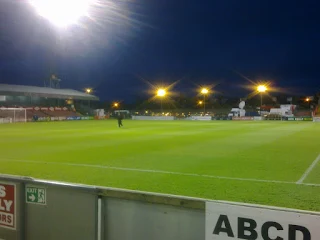
It was time for kick off, so we went out to the stand while arranging to meet up in the bar at full time. Dalymount Park had undoubtedly seen better days. The Jodi Stand was a replacement for the old Main Stand, which was demolished in 2000. It was now a single tier of seats with facilities underneath.
To the right was the Tramways End, which was a large open terrace, but was shut because the club no longer owned it. This continued around the corner to form the open far side. This had been converted to seating and had the final third demolished. The side was empty for my visit, save for the TV gantry as the match was being shown live on RTE.
Where the terrace once stood was now flat concrete, which was being used for vehicles and the away fans' coaches. Finally, the Shed End had a roof covering around two-thirds of the seats below. I managed to find a seat amongst some youths on the very back row of the stand halfway towards the Shed End.

It was quite vociferous as the Bohs' younger fans tried to get behind their team. I was impressed to see over a thousand away fans in attendance, with the Sligo supporters also making plenty of noise and waving flags. I was joined by a really nice man in the seat next to me after about ten minutes.
He told me it was chaos outside, with the club underestimating the size of the crowd. There were not many chances being created with Sligo under the management of former Wolves, Wigan Athletic, and Burnley, amongst many others, Paul Cook showing great composure. It was scoreless at halftime, with a goal not really looking like coming.
I went to the only catering point, a fish and chip van in the corner of the ground. Like the lads in the bar, they made light work of the long queue and before long I was soaking up my ale with chips and a battered burger! I asked my new pal in the seats if there had been a big crowd the previous week for the friendly match with Celtic?

He said he didn't know, as he'd been in Brazil. "Very nice," I said, but he just muttered and shook his head. It was at this point that I'd realised I'd put my size elevens in it. On Wednesday evening, I'd read in the evening Herald paper about a local football team who'd suffered a nightmare trip to Brazil and hadn't been allowed out of the airport.
He had gone as the club's referee. He wasn't very complimentary about the treatment they'd received. I quickly changed the subject! Rovers were playing well against a toothless Bohs side, and it was no surprise when they went ahead from a set-piece move. The hosts did their very best to get back into the game, but there was no way through.
I'd have doubted if they'd have scored if we'd been there until midnight. I returned to the members' bar. Tom came in a little later. There was natural disappointment in the room, which was difficult for me to show as I was relatively neutral despite wanting Bohs to win for my new mates. We started putting away some more sublime Guinness as we chatted away.

Before the game, I had mentioned my Croke Park tour to Tom. He was obviously not impressed and told me that not many others at Bohs would be. When I mentioned my love of cricket, Tom enthused. He told me of Boh's own cricket team. The day before, I was refused entry into Tallaght Stadium, the home of Shamrock Rovers, to take some photos.
He and others said they weren't surprised, but that might be to do with Rovers being Bohs' bitterest rivals. He then told me why he didn't like those involved with Croke Park and the games played there. The GAA, Gaelic Athletic Association, is an amateur body that promotes traditional Irish sports such as Gaelic Football and Hurling.
Until 1971, they banned anyone from participating who played or even attended other sports such as football, cricket, and rugby. Tom was like many young, enthusiastic schoolkids. He loved playing sports and found he was quite good at them. He was told that if he was to progress in GAA games that he was to give up British games.

Tom went on to play football at a decent level and play for Drumcondra FC, but he was still bitter about the treatment he and many of his friends were dealt with in his youth. It was gone eleven o'clock when I staggered out of the bar and found a taxi rank on the crossroads near the bar I had started in.
The ride took me back to my digs on a far more direct route than I'd walked to the ground. I'd know for next time. I woke up the next morning with a hangover from hell and a ride to the airport ahead of me, where I was joined by the depressing sight of hundreds of football fans heading to England to watch the big teams instead of supporting their local clubs.
Three weeks after my visit. Bohs finished second in the league on goal difference to Shamrock Rovers, while in November, Sligo beat Shamrock on penalties in the FAI Cup Final.
No comments:
Post a Comment